Category: Ninja Weapons

  • The Evolution of the Kunai: From Utility Tool to Iconic Ninja Weapon

    The Evolution of the Kunai: From Utility Tool to Iconic Ninja Weapon

    The Humble Origins of a Legend: More Than a Throwing Knife

    When most people think of ninja weapons, the image that immediately springs to mind is a black-clad warrior hurling a leaf-shaped blade through the air with pinpoint accuracy. While modern media has cemented the kunai as a lethal projectile, the true kunai history is far more grounded in the soil of feudal Japan. Long before it became a staple of the shinobi tools kit, the kunai was a common utility knife used by farmers and stonemasons.

    The kunai originated during the Tensho era as a multipurpose implement. Its design was never intended for the battlefield; rather, it was a tool for digging, prying, and smashing. Because it was a common household and agricultural item, it was “hidden in plain sight.” For a secret agent operating in enemy territory, carrying a sword would invite immediate execution, but carrying a kunai was as unremarkable as a modern gardener carrying a trowel.

    Anatomy of the Kunai: Form Meets Function

    The classic kunai is characterized by its distinct wedge shape and a large ring at the base of the handle. Unlike the razor-sharp katanas of the samurai, the traditional kunai was often made of soft iron. The edges were typically not sharpened because the tool was designed for prying and digging rather than slicing. Its strength lay in its durability and the leverage provided by its geometry.

    Kunai Technical Drawing Scroll

    The Significance of the Ring Pommel

    The most recognizable feature of the kunai is the ring at the end of the tang. This wasn’t just for aesthetics; it served several critical functions. A shinobi could pass a rope through the ring to secure the tool to their wrist, use it as a climbing aid, or even tie it to a long cord to create a weighted flail or a grappling hook. This adaptability is what earned it a spot in the Five Sacred Weapons of the Shinobi: A Complete Guide to the Ninja Arsenal.

    From the Field to the Shadows: The Shinobi Adaptation

    The transition from a masonry tool to a weapon of espionage was a masterclass in pragmatism. The shinobi were experts at utilizing everyday objects for clandestine purposes. The kunai’s heavy, wedge-shaped blade made it an excellent tool for boring holes into the mud-and-wattle walls of Japanese estates, allowing spies to eavesdrop on private conversations. This focus on utility over flashiness is a core tenet of The Philosophy of the Unseen: Stealth and Strategy in Shinobi Life.

    In a combat scenario, the kunai was used primarily as a stabbing or thrusting weapon. Its thick spine allowed it to withstand the pressure of being driven through light armor or into the gaps of a samurai’s plate. Because it was weighted toward the center, it could be thrown, but this was usually a last resort. A lost kunai was a lost tool, and in the world of the shinobi, losing your equipment could mean the difference between a successful extraction and a compromised mission.

    A Multi-Tool of Ancient Espionage

    The versatility of the kunai is what truly sets it apart from other ninja weapons. It was the “Swiss Army Knife” of the Sengoku period. Here are just a few ways a shinobi might utilize their kunai during a mission:

    • Climbing: By driving two kunai into the mortar of a stone wall, a ninja could create makeshift pitons to scale fortifications.
    • Digging: Whether creating a foxhole for concealment or tunneling under a fence, the kunai’s trowel-like shape was perfect for earthwork.
    • Prying: The sturdy iron construction allowed the user to pry open doors, windows, or floorboards without the blade snapping.
    • Fire Starting: When struck against a piece of flint, the iron blade could produce sparks to ignite tinder.
    Ninja with Kunai on Rooftop

    The Myth of the Throwing Knife

    Pop culture, particularly anime and film, has popularized the idea of the kunai as a primary throwing weapon. While it is true that a kunai can be thrown with lethal force, it was rarely the primary intent. The shuriken (throwing stars) were much better suited for distraction and long-range harassment. To understand the difference between these specialized tools and the broader martial application of blades, one should explore The Art of the Shinobi Blade: More Than Just a Weapon.

    The Legacy of the Kunai

    Today, the kunai remains one of the most iconic symbols of Japanese martial arts history. It represents the ingenuity of a class of warriors who had to make do with what they had, turning the tools of the peasantry into the instruments of a shadow war. The kunai history is a testament to the idea that a weapon’s effectiveness isn’t just in its edge, but in the creativity of the hand that wields it.

    Whether you view it as a simple utility knife or a legendary piece of the shinobi tools kit, the kunai’s evolution from the garden to the battlefield is a fascinating chapter in the history of warfare. It reminds us that the most dangerous weapon is often the one you never see coming—and the one that looks like it doesn’t belong on a battlefield at all.

  • The Philosophy of the Unseen: Stealth and Strategy in Shinobi Life

    The Philosophy of the Unseen: Stealth and Strategy in Shinobi Life

    In the annals of history, few figures command as much mystery and respect as the shinobi. Often reduced to mere assassins in popular culture, the true ninja were masters of a profound philosophy: the art of the unseen. This discipline, known as ninjutsu, was not just about combat; it was a comprehensive system of survival, intelligence, and psychological warfare that allowed a single individual to overcome overwhelming odds.

    The Tools of the Shadow

    A ninja’s effectiveness was inextricably linked to their equipment. Unlike the samurai, who favored the overt power of the katana, the shinobi utilized a specialized toolkit designed for utility and stealth. Every item in their arsenal served multiple purposes. A simple kunai, for instance, was as much a climbing tool and a lever as it was a weapon.

    Traditional ninja tools: Kunai, shuriken, and a scroll on a wooden table
    The essentials: A ninja’s tools were designed for versatility and silence.

    Stealth as a Strategy

    Stealth was the cornerstone of the shinobi’s existence. It was categorized into various physical techniques and psychological maneuvers. The Shinobi-aruki, or silent walking techniques, allowed a ninja to traverse wood, grass, and even water without alerting guards. But true stealth went deeper than footsteps; it involved “hiding in plain sight” through henso-jutsu (disguise), allowing the ninja to blend into any environment—be it as a monk, a merchant, or a farmer.

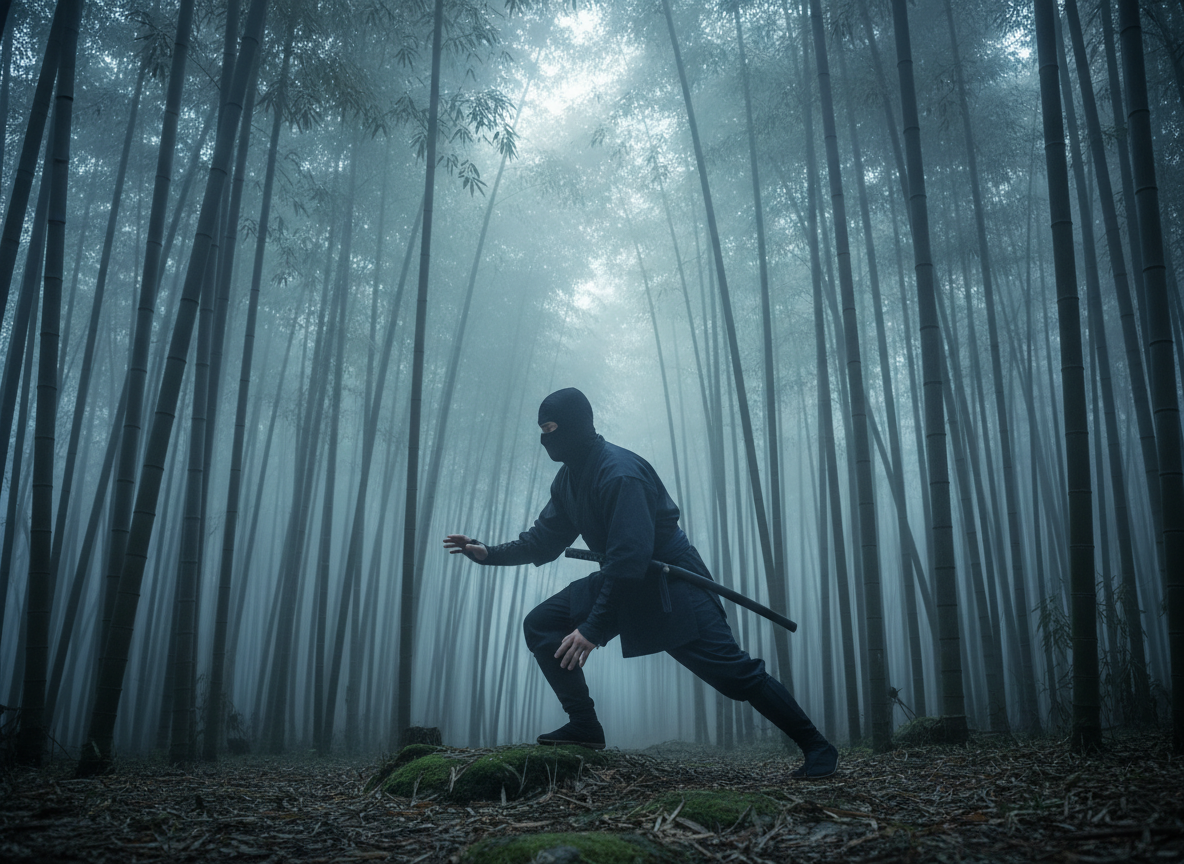
    Ninja practicing stealth in a bamboo forest
    Stealth training in the natural environment was vital for a shinobi’s survival.

    The Mind of the Shinobi

    Perhaps the most critical weapon in the ninja’s arsenal was the mind. The philosophy of fudoshin (immovable mind) allowed the shinobi to remain calm and analytical in the face of mortal danger. This mental fortitude was cultivated in the quiet solitude of the dojo, where physical training was balanced with meditation and the study of strategy.

    A quiet Japanese dojo at night with a single candle
    The dojo: A place of mental preparation and silent reflection.

    A Legacy of Discipline

    Today, the legacy of the ninja lives on not through their weapons, but through their principles of adaptability and resilience. In a world that is increasingly loud and distracting, the philosophy of the unseen reminds us of the power of silence, the value of observation, and the strength that comes from a disciplined mind and spirit.

  • The Timeless Appeal of Retro Gaming: From Mario to Tetris

    The Timeless Appeal of Retro Gaming: From Mario to Tetris

    In an era defined by photorealistic ray-tracing, sprawling open worlds, and cinematic narratives that rival Hollywood blockbusters, a curious phenomenon has taken hold of the gaming community. Instead of looking forward, millions of players are looking back. The resurgence of retro gaming is more than just a fleeting trend; it is a testament to the enduring power of pure gameplay. From the iconic “ping” of a coin collected to the rhythmic thud of a falling block, the sights and sounds of the 8-bit and 16-bit eras continue to resonate with both veteran players and a new generation of enthusiasts.

    The Mario Phenomenon: Why Platformers Endure

    When Super Mario Bros. debuted on the NES in 1985, it didn’t just save the video game industry; it defined the very language of platforming. The brilliance of Mario lies in its deceptive simplicity. Within seconds of picking up the controller, a player understands the objective: move right, jump over obstacles, and reach the flagpole. Yet, beneath that simplicity lies a masterclass in level design and physics.

    Pixel art platformer level with heroic character and coins

    The “Mario Phenomenon” persists because the controls feel like an extension of the player’s will. There is a tactile joy in the momentum of a run and the precision of a mid-air course correction. Unlike modern titles that often rely on complex tutorials and HUD-heavy interfaces, Mario teaches through play. Every Goomba encountered and every hidden block discovered reinforces a loop of curiosity and reward. This “pick-up-and-play” accessibility is why we still find ourselves traversing the Mushroom Kingdom decades later; the challenge is fair, the world is vibrant, and the satisfaction of a perfectly timed jump never fades.

    Tetris: The Perfect Puzzle Logic

    If Mario represents the pinnacle of action-platforming, Tetris represents the zenith of logical design. Created by Alexey Pajitnov in 1984, Tetris is perhaps the only “perfect” video game. It lacks a protagonist, a plot, and even a traditional ending, yet it remains one of the most addictive experiences ever devised. The core loop—arranging falling tetrominoes to clear lines—taps into a fundamental human desire for order and organization.

    Glowing neon puzzle blocks falling in a digital grid

    The genius of Tetris is its scalability. It starts at a meditative pace, allowing the player to plan and strategize, but as the levels progress, it transforms into a high-speed test of instinct and spatial awareness. This is often referred to as the “Tetris Effect,” where the game’s logic begins to permeate the player’s thoughts even after the screen is turned off. Because the mechanics are abstract and universal, Tetris doesn’t age. A line cleared in 1989 feels exactly as rewarding as a line cleared today, proving that great logic is timeless.

    Battle City and Arcade Classics: Simple Mechanics, Deep Fun

    Beyond the giants of the industry, the retro era was defined by arcade-style experiences like Battle City. These games were built on the philosophy of “easy to learn, hard to master.” In Battle City, your mission was simple: protect your base (the eagle) and destroy enemy tanks. There were no complex skill trees or moral choices—just the immediate tension of defending your territory against an encroaching force.

    8-bit top-down tank battle in a brick maze

    These arcade classics thrived on local multiplayer and high-score chasing. Whether it was the frantic cooperative play of Contra or the rhythmic patterns of Pac-Man, these games focused on the “moment-to-moment” experience. The limitations of the hardware forced developers to prioritize tight gameplay loops and creative enemy AI. This resulted in games that were incredibly focused. When you play an arcade classic, you aren’t just killing time; you are engaging in a distilled form of digital competition that rewards reflexes and pattern recognition above all else.

    Conclusion: Why We Keep Coming Back

    Why do we return to these pixelated worlds when we have the power of modern consoles at our fingertips? Part of it is undoubtedly nostalgia—the desire to recapture the magic of sitting in front of a glowing CRT television on a Saturday morning. However, nostalgia alone cannot sustain an entire industry of remakes, remasters, and retro-inspired “boomer shooters.”

    We come back because retro games respect our time. They offer immediate engagement without the bloat of modern “live service” features. They remind us that at its core, gaming is about the joy of movement, the thrill of a challenge, and the satisfaction of a solved puzzle. As long as there are players who value tight mechanics and iconic art styles, the 8-bit heart of the gaming world will never stop beating.

  • Искусство Дзёхо-дзюцу: Мастерство информации от ниндзя до эпохи соцсетей

    Искусство Дзёхо-дзюцу: Мастерство информации от ниндзя до эпохи соцсетей

    В мире ниндзя победа ковалась не только остротой клинка, но и глубиной знаний. Пока самураи оттачивали мастерство владения мечом на полях сражений, синоби совершенствовали Дзёхо-дзюцу — искусство сбора, анализа и манипуляции информацией. В 2026 году, когда информационные потоки стали быстрее звука, древние принципы ниндзя обретают пугающую актуальность.

    Дзёхо-дзюцу: Информационная война прошлого

    Для ниндзя информация (дзёхо) была ценнее золота. Мастер Дзёхо-дзюцу знал, что правильно поданный слух может разрушить замок эффективнее, чем сотня пороховых зарядов. Основой этого искусства была система Гокан-но-дзюцу — использование пяти типов шпионов, от местных жителей до высокопоставленных чиновников.

    Синоби использовали психологическое давление, дезинформацию и тщательное наблюдение. Они умели «читать» небо (Тэмон) и землю (Тимон), чтобы предсказывать передвижения врага. Но самое главное — они понимали ценность источника. Сегодня, в эпоху «информационного шума», это умение отделять зерна от плевел становится жизненно важным.

    2025: Великий перелом — Соцсети против ТВ

    Согласно последним данным (RISJ Digital News Report 2025), мы стали свидетелями исторического сдвига. Впервые в истории социальные сети обошли телевидение как основной источник новостей. В США этот показатель достиг 54%, в то время как телевидение упало до 50%, а новостные сайты — до 48%.

    Ниндзя прошлого назвали бы это идеальной средой для «скрытого влияния». Когда информация фрагментирована и передается через лидеров мнений (инфлюенсеров), она становится максимально податливой для манипуляций. Современные алгоритмы соцсетей работают как невидимые мастера шпионажа, подсовывая нам именно то, что мы хотим увидеть.

    [ai_chart type=”chatgpt”]

    Видео — новое оружие ниндзя

    Отчет 2025 года подтверждает: «поворот к видео» (pivot to video) наконец-то стал реальностью. YouTube и TikTok доминируют в потреблении новостей, особенно среди молодежи. В США охват видео-новостей вырос с 55% до 72% всего за несколько лет. Для современного «цифрового ниндзя» это означает, что визуальный образ и короткий ролик теперь сильнее тысячи слов в свитке.

    Искусственный интеллект: Новый союзник синоби

    ИИ проникает во все сферы, включая сбор новостей. В таких странах, как Индия и Таиланд, читатели уже привыкли к ИИ-ведущим и автоматическим сводкам. Около 4% пользователей по всему миру используют ChatGPT для получения новостей, а в Индии этот показатель достигают 19%. ИИ становится инструментом, который может как разоблачать ложь, так и создавать идеальные дипфейки — современное воплощение техники Саймин-дзюцу (гипноза и внушения).

    Заключение: Путь современного мастера информации

    Ниндзя верили, что информация — это не просто данные, а инструмент выживания. В мире, где соцсети заменили вечерние новости, а ИИ пишет заголовки, мы все становимся участниками бесконечной информационной войны. Искусство Дзёхо-дзюцу сегодня — это критическое мышление, проверка источников и умение сохранять ясность ума в океане цифровых манипуляций.

    Будьте бдительны, как истинные синоби. Мир меняется, но принципы мастерства остаются вечными.

  • Искусство Сюрикэндзюцу: Секреты метательного оружия ниндзя

    Искусство Сюрикэндзюцу: Секреты метательного оружия ниндзя

    Искусство Сюрикэндзюцу: Секреты метательного оружия ниндзя

    В сумерках японского средневековья, когда тени становились длиннее, а границы между реальностью и легендой стирались, рождалось одно из самых загадочных боевых искусств — сюрикэндзюцу. Это не просто умение метать заточенные куски металла; это сложная философская и техническая дисциплина, входившая в обязательную программу подготовки не только легендарных ниндзя (синоби), но и многих самурайских школ. Само название «сюрикэндзюцу» дословно переводится как «искусство лезвия, скрытого в руке», что идеально отражает суть этого скрытного и эффективного оружия. Часто это искусство дополнялось использованием другого оружия ниндзя, такого как кусаригама.

    Сюрикэн никогда не рассматривался как основное оружие воина. В арсенале синоби он занимал нишу вспомогательного средства (хондзё-дзюцу), предназначенного для того, чтобы выиграть секунды, дезориентировать противника или нанести ему досадную рану, мешающую продолжению погони. В этой статье мы погрузимся в мир холодного металла и узнаем, какие секреты хранят в себе знаменитые «звездочки» и менее известные «стержни».

    Хира-сюрикен: Смертоносные «звезды» ночи

    Хира-сюрикен (или сякэн) — это именно то оружие, которое всплывает в памяти при слове «ниндзя». Эти плоские металлические пластины в форме звезд или многоугольников изготавливались из тонкой стали. Интересно, что прообразом хира-сюрикенов часто служили вполне бытовые предметы: строительные шайбы, монеты или детали дверных замков. Это позволяло воину тени оставаться незамеченным даже при обыске — кто заподозрит в плоской железке смертоносный клинок?

    Существовало огромное разнообразие форм хира-сюрикенов:

    • Сампо-сюрикен: трехлучевая звезда, отличающаяся высокой проникающей способностью.
    • Сихо-сюрикен: классическая четырехлучевая форма, наиболее распространенная из-за простоты изготовления и баланса.
    • Роппо-сюрикен: шестилучевое лезвие, которое при вращении создавало практически непрерывную режущую кромку.
    • Мадзи-сюрикен: в форме свастики (символа удачи и вечности в буддизме), обладающая специфической аэродинамикой.

    Основное преимущество хира-сюрикена заключалось в его вращении. Благодаря центробежной силе, «звездочка» стабилизировалась в полете, что позволяло даже не самому опытному бойцу поражать цель на расстоянии до 10–15 метров. Однако за кажущейся простотой скрывались годы тренировок по расчету траектории и силы броска.

    Бо-сюрикен: Искусство стального стержня

    Если хира-сюрикен — это символ массовой культуры, то бо-сюрикен — это выбор истинных мастеров и профессионалов. Бо-сюрикен представляет собой цилиндрический, четырехгранный или восьмигранный стержень, заостренный с одного (иногда с двух) концов. Его длина обычно составляла от 12 до 21 сантиметра, а вес варьировался в зависимости от школы и предпочтений владельца.

    Метание бо-сюрикена — задача куда более сложная, чем бросок «звездочки». Здесь использовались две основные техники:

    • Дзики да-хо: метод прямого броска, при котором стержень летит к цели, не переворачиваясь в воздухе. Это требовало филигранного контроля кисти и пальцев.
    • Хантэн да-хо: метод броска с полуоборотом, когда оружие переворачивается один раз перед попаданием в цель.

    Бо-сюрикены часто изготавливались из обычных плотницких гвоздей или длинных игл для волос. Мастера школы Катори Синто-рю или Нэгиси-рю могли метать эти стержни с поразительной точностью, пробивая доспехи или попадая в незащищенные щели шлема. В отличие от «звезд», бо-сюрикен обладал большей пробивной силой и мог использоваться в ближнем бою как импровизированный стилет.

    Техника метания и тактическое коварство

    Главный секрет сюрикэндзюцу заключается в том, что это оружие редко использовалось для прямого убийства. В условиях реального боя убить человека одним броском сюрикена крайне сложно — для этого нужно попасть точно в глаз или в сонную артерию. Настоящая сила сюрикена заключалась в тактическом преимуществе.

    Синоби использовали сюрикены как средство психологического давления и отвлечения внимания (мэцубуси). Представьте: преследователь бежит за ниндзя, и вдруг в его лицо летит блестящий предмет. Инстинктивная реакция — закрыться рукой или уклониться. Этой секунды ниндзя хватало, чтобы либо исчезнуть в зарослях, либо выхватить меч и нанести решающий удар. Сюрикены также метали в ноги, чтобы замедлить погоню, или использовали их для создания шума в стороне, отвлекая часовых.

    Кроме того, сюрикены часто применялись как вспомогательный инструмент: ими можно было поддеть засов, вырезать отверстие в бумажной перегородке или даже использовать их в качестве альпинистских зацепов при подъеме на стену.

    Мифы и реальность: Яд и «смертельные звездочки»

    Вокруг сюрикенов сложилось немало легенд, подогретых кинематографом. Самый популярный миф — это то, что каждый сюрикен был смазан смертельным ядом. В реальности это происходило гораздо реже, чем принято считать. Яды растительного (аконит) или животного происхождения были дорогими и быстро теряли свои свойства на открытом воздухе.

    Однако ниндзя действительно использовали «грязные» приемы. Сюрикены могли закапывать в землю или навоз, чтобы на лезвиях размножались бактерии, вызывающие гангрену или столбняк. Даже легкая царапина таким оружием в условиях отсутствия антибиотиков могла стать смертельной через несколько дней. Таким образом, сюрикен становился оружием отложенного действия.

    Еще один миф гласит, что сюрикены были исключительно оружием ниндзя. Исторические хроники подтверждают, что многие самурайские кланы практиковали сюрикэндзюцу. Для самурая это было достойным дополнением к искусству владения мечом, позволяющим нейтрализовать противника на дистанции.

    Заключение

    Искусство сюрикэндзюцу — это памятник человеческой изобретательности и адаптивности. Оно учит нас тому, что эффективность оружия зависит не от его размера или разрушительной мощи, а от мастерства и хитрости того, кто его держит. Сегодня сюрикэндзюцу продолжает жить в рамках традиционных школ боевых искусств (Корю), где ученики по-прежнему оттачивают точность броска, стремясь достичь единства духа, тела и летящего металла.

    Сюрикен остается символом эпохи, когда победа ковалась не только силой мышц, но и остротой ума. Это искусство напоминает: в руках мастера даже обычный кусок стали может стать ключом к выживанию в самом безнадежном сражении.

  • Тайные послания: Искусство стеганографии и скрытой связи ниндзя

    Тайные послания: Искусство стеганографии и скрытой связи ниндзя

    Тайные послания: Искусство стеганографии и скрытой связи ниндзя

    В эпоху Сенгоку, когда Япония была раздираема междоусобными войнами, информация ценилась дороже золота и острее самого качественного меча. Для легендарных синоби, более известных нам как ниндзя, успех миссии и сама жизнь зависели от способности передать разведданные незаметно для врага. В условиях тотальной слежки и блокпостов на дорогах, обычное письмо могло стать смертным приговором. Именно поэтому ниндзя довели искусство стеганографии — сокрытия самого факта передачи сообщения — до совершенства. В отличие от криптографии, которая делает текст нечитаемым, стеганография делает его невидимым для непосвященных, маскируя под обыденные предметы или природные явления.

    Госики-маи: Язык пятицветного риса

    Одним из самых оригинальных и эффективных методов полевой связи ниндзя была техника Госики-маи (Goshiki-mai), что буквально означает «пятицветный рис». Этот метод позволял агентам оставлять сообщения прямо на виду у противника, не вызывая ни малейшего подозрения. Рис окрашивался в пять специфических цветов: синий (или фиолетовый), желтый, красный, черный и белый.

    Почему именно рис? В феодальной Японии рассыпанное зерно на обочине дороги или у подножия храма было обычным делом — его могли обронить крестьяне или оставить в качестве подношения духам. Однако для посвященного комбинация зерен разного цвета была сложным кодом. Основные принципы Госики-маи включали:

    • Уникальные комбинации: Существовало более 100 различных сочетаний, каждое из которых имело свое значение — от «враг близко» до «встречаемся в полночь».
    • Защита от птиц: Ниндзя использовали специальные органические красители, которые делали рис горьким или ядовитым для птиц, чтобы сообщение не было «съедено» до того, как его прочитает адресат.
    • Естественная маскировка: Для обычного самурая или стражника это была просто горсть мусора, в то время как связной ниндзя получал четкие инструкции.

    Абури-даси: Магия невидимых чернил

    Если сообщение требовало подробного изложения и должно было быть передано на бумаге, ниндзя прибегали к технике Абури-даси. Это искусство создания невидимых чернил, которые проявлялись только при определенных условиях, чаще всего — при нагревании над огнем.

    Технология изготовления таких чернил была разнообразной и зависела от доступных ресурсов:

    • Рисовый отвар: Самый простой способ. Крахмалистая вода после высыхания становилась невидимой, но при легком обжиге бумаги буквы приобретали коричневый оттенок.
    • Сок растений: Использовался сок редьки дайкон или других плодов. Органические кислоты в их составе разрушали структуру бумаги, делая эти места более чувствительными к теплу.
    • Специфические реагенты: В более сложных вариантах использовались химические составы, которые проявлялись не от тепла, а при погружении бумаги в воду или при воздействии другого «проявляющего» состава.

    Агент мог нести свиток с невинным рисунком или обычным текстом о погоде, между строк которого скрывались истинные приказы. Даже если ниндзя попадал в плен, обыск не давал врагу никаких улик.

    Синоби-ироха: Секретный алфавит теней

    Когда возникала необходимость записать информацию так, чтобы ее нельзя было прочесть даже после обнаружения, использовался Синоби-ироха. Это был специализированный шифр, основанный на замене стандартных японских слогов (кана) на уникальные символы.

    Система Синоби-ироха была построена на логике кандзи, но в измененном виде. Часто за основу брались семь ключевых элементов (радикалов), таких как «дерево», «огонь», «земля», «золото», «вода», «человек» и «тело». Комбинируя эти элементы с дополнительными штрихами, ниндзя создавали 48 знаков, соответствующих алфавиту ироха.
    Для постороннего человека такой текст выглядел как бессмысленный набор иероглифов или даже как странный орнамент. Каждая школа ниндзя (рю) могла иметь свою модификацию этого алфавита, что делало перехват сообщения практически бесполезным для контрразведки противника.

    Наследие невидимых мастеров

    Методы скрытой связи ниндзя — это не просто исторический курьез. Они демонстрируют глубокое понимание психологии восприятия и химии. Ниндзя знали: лучшая защита информации — это не сложный замок, а уверенность врага в том, что никакой информации нет.

    Сегодня принципы Госики-маи и Абури-даси находят свое отражение в цифровой стеганографии, где секретные данные прячутся внутри пикселей обычных фотографий или в метаданных файлов. Искусство «невидимости», зародившееся в тени японских замков, продолжает жить в эпоху киберпространства, напоминая нам о том, что в битве за информацию побеждает не самый сильный, а самый изобретательный.

    Ниндзя Chronicles продолжает изучать тайны прошлого, чтобы лучше понимать технологии будущего. Оставайтесь в тени, но держите глаза открытыми.

  • The Hidden Edge: A Guide to Concealed Shinobi Blades for Modern Practitioners

    The Hidden Edge: A Guide to Concealed Shinobi Blades for Modern Practitioners

    The allure of the concealed Shinobi blade lies in its duality. It is a testament to both the lethality of the warrior and the cleverness of the inventor. These weapons remind us that power is not always found in the most overt display, but often in the quiet, the unseen, and the prepared. Whether viewed as historical artifacts of a bygone era of espionage or as masterpieces of modern smithing, the hidden edge remains a potent symbol of the Shinobi spirit.

    The Shikomizue: The Masterpiece of Deception

    Perhaps the most iconic of all concealed Shinobi weapons is the Shikomizue, or “prepared cane.” To the untrained eye, the Shikomizue appeared to be nothing more than a simple wooden walking stick or a monk’s staff. However, within its hollowed-out koshirae (mountings) lay a razor-sharp blade. Unlike the traditional Katana, the Shikomizue typically lacked a tsuba (handguard), as a guard would immediately betray the object’s true nature as a weapon.

    Conclusion: The Enduring Appeal of the Hidden Edge

    For the modern practitioner, studying these weapons offers more than just technical knowledge; it provides a window into a philosophy where adaptability is the greatest weapon of all. In a world that is increasingly loud and transparent, there is a profound, mysterious respect to be found in the blade that waits silently in the shadows, ready to emerge only when the moment is exactly right.

  • The Art of Ninja Knife Throwing: History, Technique & Mastery

    The Art of Ninja Knife Throwing: History, Technique & Mastery

    Few martial skills carry the mystique and lethal elegance of the ninja’s ability to throw a blade with pinpoint accuracy. Whether streaking through the shadows of feudal Japan or practiced by modern enthusiasts in dojos worldwide, knife throwing represents the perfect union of physics, discipline, and artistry. In this guide, we’ll explore the rich history behind this ancient skill, the weapons used, the techniques that define mastery, and how you can begin your own journey into this captivating discipline.

    A Weapon Born in the Shadows: The History of Ninja Knife Throwing

    The art of throwing edged weapons stretches back thousands of years, but it was the shinobi — the legendary spies and assassins of feudal Japan — who elevated it to an art form. Known as shurikenjutsu, the technique of throwing bladed instruments was a core component of ninjutsu, the secretive martial system of the ninja.

    Unlike the glamorized Hollywood version, ninja knife throwing was never intended as a killing blow. Instead, it served as a distraction — a way to create enough of a window to flee, to close distance, or to disarm an opponent. The psychological impact of a spinning blade appearing out of nowhere was often just as powerful as the physical threat it posed.

    A flat-lay arrangement of traditional Japanese ninja throwing weapons including shuriken and kunai
    Traditional ninja throwing weapons: shuriken, kunai, and bo-shuriken — each designed for a specific purpose and throwing style.

    Know Your Blades: Types of Throwing Knives and Ninja Weapons

    Not all throwing blades are created equal. The world of ninja throwing weapons is diverse, with each design optimized for different throwing styles, distances, and purposes. Here are the most iconic types:

    • Kunai: Perhaps the most iconic ninja tool, the kunai originated as a farming implement before being adopted as a multi-purpose weapon. Its leaf-shaped blade and ring pommel make it well-balanced for throwing and useful for climbing.
    • Shuriken (Hira-shuriken): The classic “throwing star,” available in multiple shapes — from four-pointed (ninja-to) to the more complex eight-pointed varieties. Designed to be thrown flat with a flick of the wrist.
    • Bo-shuriken: A spike or straight blade thrown end-over-end or in a straight trajectory. Requires significant technique but is devastatingly accurate in experienced hands.
    • Modern Sport Throwing Knives: Today’s practitioners often use purpose-built throwing knives — balanced, blunt-spined, and typically 12–16 inches in length — designed for sport and training safety.

    The Grip: Where Mastery Begins

    Every expert thrower will tell you the same thing: the grip is everything. It determines the rotation of the blade, the release point, and ultimately where the knife lands. There are two fundamental grip styles used in knife throwing:

    Close-up of skilled hands demonstrating the proper pinch grip for knife throwing
    The pinch grip — the foundation of accurate knife throwing. Notice how the thumb and forefinger secure the spine of the blade without gripping too tightly.

    The Blade Grip

    Hold the knife by the blade (spine, not the edge), with the tip pointing away from you. Your thumb rests flat along the flat of the blade and your fingers curl underneath. This grip is used when you want the handle to strike the target first after a single rotation. It’s typically used at shorter distances — around 10–12 feet.

    The Handle Grip

    Grip the handle firmly but not tightly — think of it like holding a bird: tight enough that it can’t escape, gentle enough that you don’t crush it. The handle grip allows the blade to rotate so the tip strikes the target first. It’s preferred at greater distances — typically 14–20 feet for a single rotation.

    The universal key with either grip is a clean, smooth release. The knife should leave your hand at the same point every single time. Inconsistency in release is the number-one cause of errant throws — not the rotation, not the distance, but the moment of letting go.

    Target Practice: Building Consistency Through Repetition

    No skill is built without dedicated, deliberate practice — and knife throwing is no exception. A proper target setup is essential both for safety and skill development.

    A traditional wooden target board with multiple throwing knives embedded from practice
    A well-worn target board tells the story of countless hours of practice. Notice the tight grouping — the hallmark of a skilled thrower building muscle memory.

    Choosing the Right Target

    The ideal target for knife throwing is a thick slab of end-grain wood, typically from soft to medium hardness trees like pine, basswood, or cottonwood. End-grain targets absorb impact evenly, grip the blade on entry, and last significantly longer than face-grain alternatives. Aim for a target at least 12 inches thick and 18–24 inches in diameter.

    Distance and Rotation

    Understanding throwing distance is critical. Each full rotation of the knife covers approximately 6–8 feet of distance, depending on the weight and length of the blade. New throwers should start at a half-rotation distance (around 6 feet) and work outward. Mark your distances clearly and only change them once you achieve consistent, clean sticks at your current distance.

    Safety First: The Ninja’s Code of Respect

    The ninja’s greatest weapon was never a blade — it was discipline. Before you throw a single knife, internalize these non-negotiable safety rules:

    • Establish a clear range: Ensure no one can walk into the throwing lane from any direction.
    • Never throw toward people or animals: This seems obvious, but adrenaline and confidence can cloud judgment.
    • Inspect your blades before every session: Check for cracks, loose handles, or damaged tips that could alter trajectory.
    • Use a proper backstop: A solid wooden backstop behind your target will catch any knives that pass through or bounce off.
    • Always approach the target from the side: Walk parallel to the target when retrieving knives — never directly toward it until you’re certain all throwing has stopped.

    The Path to Mastery: Train Like a Ninja

    True mastery of knife throwing — like any martial art — is not measured in tricks or distance records. It’s measured in consistency, control, and the quiet confidence of a practitioner who knows exactly what their body and blade will do before the throw is made.

    Start with a single knife. Throw it a thousand times at the same distance before moving further back. Focus obsessively on your release point, your stance, and your follow-through. Record yourself on video to spot inconsistencies invisible to the naked eye.

    Join a community — the knife throwing world is surprisingly welcoming, from local clubs to international organizations like the American Knife Throwers Alliance (AKTA) and the Knife Throwers Hall of Fame. Connect, compete, and learn from practitioners who’ve put in the hours you aspire to.

    The blade doesn’t lie. Every throw tells the truth about your technique. Embrace that honesty, learn from every miss, and let the pursuit of the perfect stick become your meditation. That’s not just knife throwing — that’s the way of the ninja.

  • The Art of Ninja Knife Throwing: History, Technique & Mastery

    The Art of Ninja Knife Throwing: History, Technique & Mastery

    Few martial skills carry the mystique and lethal elegance of the ninja’s ability to throw a blade with pinpoint accuracy. Whether streaking through the shadows of feudal Japan or practiced by modern enthusiasts in dojos worldwide, knife throwing represents the perfect union of physics, discipline, and artistry. In this guide, we’ll explore the rich history behind this ancient skill, the weapons used, the techniques that define mastery, and how you can begin your own journey into this captivating discipline.

    A Weapon Born in the Shadows: The History of Ninja Knife Throwing

    The art of throwing edged weapons stretches back thousands of years, but it was the shinobi — the legendary spies and assassins of feudal Japan — who elevated it to an art form. Known as shurikenjutsu, the technique of throwing bladed instruments was a core component of ninjutsu, the secretive martial system of the ninja.

    Unlike the glamorized Hollywood version, ninja knife throwing was never intended as a killing blow. Instead, it served as a distraction — a way to create enough of a window to flee, to close distance, or to disarm an opponent. The psychological impact of a spinning blade appearing out of nowhere was often just as powerful as the physical threat it posed.

    A flat-lay arrangement of traditional Japanese ninja throwing weapons including shuriken and kunai
    Traditional ninja throwing weapons: shuriken, kunai, and bo-shuriken — each designed for a specific purpose and throwing style.

    Know Your Blades: Types of Throwing Knives and Ninja Weapons

    Not all throwing blades are created equal. The world of ninja throwing weapons is diverse, with each design optimized for different throwing styles, distances, and purposes. Here are the most iconic types:

    • Kunai: Perhaps the most iconic ninja tool, the kunai originated as a farming implement before being adopted as a multi-purpose weapon. Its leaf-shaped blade and ring pommel make it well-balanced for throwing and useful for climbing.
    • Shuriken (Hira-shuriken): The classic “throwing star,” available in multiple shapes — from four-pointed (ninja-to) to the more complex eight-pointed varieties. Designed to be thrown flat with a flick of the wrist.
    • Bo-shuriken: A spike or straight blade thrown end-over-end or in a straight trajectory. Requires significant technique but is devastatingly accurate in experienced hands.
    • Modern Sport Throwing Knives: Today’s practitioners often use purpose-built throwing knives — balanced, blunt-spined, and typically 12–16 inches in length — designed for sport and training safety.

    The Grip: Where Mastery Begins

    Every expert thrower will tell you the same thing: the grip is everything. It determines the rotation of the blade, the release point, and ultimately where the knife lands. There are two fundamental grip styles used in knife throwing:

    Close-up of skilled hands demonstrating the proper pinch grip for knife throwing
    The pinch grip — the foundation of accurate knife throwing. Notice how the thumb and forefinger secure the spine of the blade without gripping too tightly.

    The Blade Grip

    Hold the knife by the blade (spine, not the edge), with the tip pointing away from you. Your thumb rests flat along the flat of the blade and your fingers curl underneath. This grip is used when you want the handle to strike the target first after a single rotation. It’s typically used at shorter distances — around 10–12 feet.

    The Handle Grip

    Grip the handle firmly but not tightly — think of it like holding a bird: tight enough that it can’t escape, gentle enough that you don’t crush it. The handle grip allows the blade to rotate so the tip strikes the target first. It’s preferred at greater distances — typically 14–20 feet for a single rotation.

    The universal key with either grip is a clean, smooth release. The knife should leave your hand at the same point every single time. Inconsistency in release is the number-one cause of errant throws — not the rotation, not the distance, but the moment of letting go.

    Target Practice: Building Consistency Through Repetition

    No skill is built without dedicated, deliberate practice — and knife throwing is no exception. A proper target setup is essential both for safety and skill development.

    A traditional wooden target board with multiple throwing knives embedded from practice
    A well-worn target board tells the story of countless hours of practice. Notice the tight grouping — the hallmark of a skilled thrower building muscle memory.

    Choosing the Right Target

    The ideal target for knife throwing is a thick slab of end-grain wood, typically from soft to medium hardness trees like pine, basswood, or cottonwood. End-grain targets absorb impact evenly, grip the blade on entry, and last significantly longer than face-grain alternatives. Aim for a target at least 12 inches thick and 18–24 inches in diameter.

    Distance and Rotation

    Understanding throwing distance is critical. Each full rotation of the knife covers approximately 6–8 feet of distance, depending on the weight and length of the blade. New throwers should start at a half-rotation distance (around 6 feet) and work outward. Mark your distances clearly and only change them once you achieve consistent, clean sticks at your current distance.

    Safety First: The Ninja’s Code of Respect

    The ninja’s greatest weapon was never a blade — it was discipline. Before you throw a single knife, internalize these non-negotiable safety rules:

    • Establish a clear range: Ensure no one can walk into the throwing lane from any direction.
    • Never throw toward people or animals: This seems obvious, but adrenaline and confidence can cloud judgment.
    • Inspect your blades before every session: Check for cracks, loose handles, or damaged tips that could alter trajectory.
    • Use a proper backstop: A solid wooden backstop behind your target will catch any knives that pass through or bounce off.
    • Always approach the target from the side: Walk parallel to the target when retrieving knives — never directly toward it until you’re certain all throwing has stopped.

    The Path to Mastery: Train Like a Ninja

    True mastery of knife throwing — like any martial art — is not measured in tricks or distance records. It’s measured in consistency, control, and the quiet confidence of a practitioner who knows exactly what their body and blade will do before the throw is made.

    Start with a single knife. Throw it a thousand times at the same distance before moving further back. Focus obsessively on your release point, your stance, and your follow-through. Record yourself on video to spot inconsistencies invisible to the naked eye.

    Join a community — the knife throwing world is surprisingly welcoming, from local clubs to international organizations like the American Knife Throwers Alliance (AKTA) and the Knife Throwers Hall of Fame. Connect, compete, and learn from practitioners who’ve put in the hours you aspire to.

    The blade doesn’t lie. Every throw tells the truth about your technique. Embrace that honesty, learn from every miss, and let the pursuit of the perfect stick become your meditation. That’s not just knife throwing — that’s the way of the ninja.

  • The Art of the Shadow: A Complete Guide to Ninja Blades and Japanese Throwing Weapons

    The Art of the Shadow: A Complete Guide to Ninja Blades and Japanese Throwing Weapons

    For centuries, the ninja — Japan’s legendary shadow warriors — were as famous for their blades as they were for their stealth. More than mere weapons, ninja knives and throwing tools were precision instruments of survival, each one forged with extraordinary care by master craftsmen. Today, these blades continue to captivate collectors, martial artists, and history enthusiasts around the world.

    The Iconic Weapons of the Shinobi

    When most people think of ninja weapons, the shuriken — the iconic throwing star — immediately comes to mind. But the true arsenal of a shinobi was far more nuanced and sophisticated. From concealed blades to multi-purpose utility knives, every tool had a purpose rooted in tactical necessity.

    The tanto (短刀), a short Japanese dagger typically 15–30 cm in length, was among the most versatile blades in the ninja’s kit. Unlike the curved katana, the tanto featured a straight or slightly curved blade optimized for thrusting — ideal for close-quarters combat where larger weapons became a liability.

    Japanese master swordsmith forging a traditional ninja blade in a glowing forge

    The Craft of Forging: Where Steel Meets Tradition

    The creation of a traditional Japanese blade is one of the most demanding and respected crafts in the world. Japanese bladesmiths — known as tōshō — spend decades mastering the art of tamahagane steel production, the foundation of all authentic Japanese blades.

    The process begins with smelting iron sand in a traditional clay furnace called a tatara. Over several days, the smelter produces raw tamahagane steel, which is then carefully selected, folded, and hammered by the smith. This folding process — which can be repeated dozens of times — removes impurities and creates the distinctive grain patterns visible in high-quality blades.

    • Forging (Kitae): The steel is heated, folded, and hammered to refine its structure
    • Shaping (Sori): The blade’s distinctive curve is formed through differential cooling
    • Hardening (Yakiire): Clay coating and water quenching create the hard edge and softer spine
    • Polishing (Togi): Hours of hand-polishing reveal the blade’s hamon (temper line) and grain

    This meticulous process can take weeks or even months for a single blade — a testament to the dedication Japanese smiths bring to their craft.

    Shuriken, Kunai, and the Full Ninja Toolkit

    Beyond the tanto and short sword, ninja relied on a range of specialized throwing and utility blades. Understanding the differences between these tools helps separate historical fact from Hollywood myth.

    Collection of authentic Japanese ninja tools including shuriken, kunai, and kogatana blades

    Hira-Shuriken (Throwing Stars)

    The flat, star-shaped hira-shuriken is the most recognizable ninja weapon worldwide. Contrary to popular belief, shuriken were not primarily lethal weapons — they were distraction tools. A skilled shinobi would throw them to create an opening for escape or to force an enemy into an unfavorable position.

    Traditional shuriken came in many shapes: 4-pointed, 6-pointed, 8-pointed, and even asymmetrical designs unique to specific ninja clans. Each design carried slightly different aerodynamic properties, and ninja would train extensively with specific patterns they favored.

    Kunai — The Multi-Purpose Tool

    Perhaps the most versatile item in the ninja’s arsenal, the kunai was originally a simple agricultural and masonry tool — essentially a trowel with a spike. Ninja repurposed it as a climbing aid, a digging implement, a prying tool, and yes, a weapon. The distinctive ring pommel allowed the kunai to be attached to rope for grappling or retrieval after throwing.

    Modern kunai reproductions are popular among martial arts practitioners and collectors alike, valued both for their historical significance and their elegant, functional design.

    Kogatana — The Hidden Utility Blade

    The kogatana (小刀, “small blade”) is a tiny utility knife traditionally housed in a slot in a samurai’s or ninja’s sword scabbard. Despite its small size — typically just 9–10 cm — the kogatana served dozens of purposes: writing implements, eating utensils, first aid tools, and last-resort weapons. Its compact design made it easy to conceal and carry at all times.

    The Enduring Legacy of Ninja Blade Culture

    Dramatic ninja silhouette holding a katana against a full moon

    Five centuries after the golden age of the shinobi, ninja blade culture is experiencing a remarkable renaissance. From serious martial arts practitioners training with traditional weapons to passionate collectors seeking authentic, hand-forged reproductions — the demand for quality Japanese blades has never been stronger.

    What drives this enduring fascination? In part, it’s the extraordinary craftsmanship — the knowledge that every blade represents hundreds of hours of skilled labor and centuries of refined technique. But there’s also something deeper: these weapons embody a philosophy. The ninja believed that a blade was only as good as the discipline of its wielder. Mastery of the weapon required mastery of the self.

    Whether you’re a collector, a history enthusiast, a martial arts practitioner, or simply someone who appreciates extraordinary craftsmanship, the world of ninja blades offers a lifetime of exploration. Each blade has a story — of the ore from which it was born, the hands that shaped it, and the tradition it carries forward.

    Choosing Your First Ninja Blade

    If you’re considering adding a Japanese blade to your collection, here are the key factors to consider:

    • Steel type: Look for high-carbon steel (1045, 1060, 1095) or traditional tamahagane for authentic pieces
    • Full tang construction: Ensures the blade extends through the entire handle for maximum strength and balance
    • Heat treatment: Proper differential hardening creates the distinctive hamon and ensures edge retention
    • Provenance: Authentic pieces from reputable smiths or verified vendors hold their value and quality over time
    • Purpose: Display pieces, martial arts practice blades, and cutting tools have different requirements — know your intent before purchasing

    The shadow warriors of feudal Japan left behind a legacy etched in steel. In every hand-forged shuriken, every carefully balanced kunai, every precisely tempered tanto blade — the spirit of the shinobi endures. Welcome to the world of ninja blades.